
UK Proposes under 16s social media ban
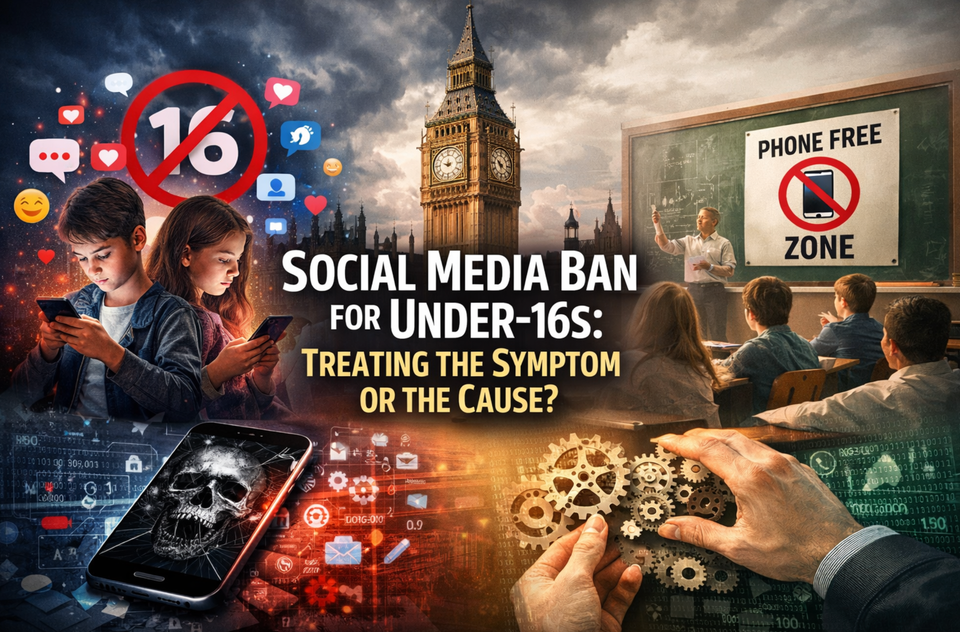
Are We Treating the Symptom or the Cause?
The UK government is once again circling one of the most emotionally charged questions in modern tech policy. Should children under 16 be banned from social media?
A new consultation has been launched to examine children’s use of mobile phones and social platforms, with proposals ranging from stricter age verification to outright age based bans. The move follows growing political pressure, public concern, and international examples, most notably Australia’s decision to restrict under-16 access to social platforms.
At the same time, regulators are investigating platforms like X after reports of sexualised images being generated using its AI system, Grok. The message from policymakers is clear. Something has to change.
But what exactly are we trying to fix?
Why this conversation has accelerated
Momentum behind a potential ban did not appear overnight. More than 60 MPs have reportedly urged the Prime Minister, Keir Starmer, to take action. Medical bodies are now calling excessive phone use a public health issue. Teachers are pointing to classroom disruption. Parents are exhausted from being the sole line of defence against platforms designed to be addictive.
Government proposals currently being discussed include:
- Raising the minimum age for social media access, potentially to 16
- Improving age verification technologies
- Reassessing whether the current digital age of consent is too low
- Restricting addictive design patterns such as infinite scrolling and streaks
- Making phone free schools the default
Nearly all UK schools already have phone policies in place, yet enforcement remains inconsistent. According to recent figures, more than half of secondary school pupils report phones being used in lessons without permission. Ofsted will now assess how effectively schools enforce these rules, with support offered to those struggling to do so.
The appeal of a blanket ban
On the surface, an age based ban feels decisive. It offers clarity for parents, removes ambiguity for schools, and sends a strong signal to technology companies. Supporters often compare this moment to historic public health interventions like smoking restrictions. Once society accepted the harm, regulation followed.
There is also a powerful argument that legal change makes it easier for families to hold the line together. If the rule applies to everyone, parents are no longer cast as the villain when they say no.
For many campaigners, this is not about politics. It is about child development, wellbeing, and preventing long term harm before it becomes irreversible.
The risks we are not talking about enough
Critics of a ban are not defending the status quo. Many openly acknowledge that current platform designs are harmful. Their concern lies elsewhere.
A blanket ban risks treating participation as the problem rather than design, incentives, and governance. It may push usage underground, reward platforms that are better at evasion, and disproportionately affect vulnerable children who rely on online spaces for connection and support.
There is also a deeper question about responsibility. If we remove children entirely from digital public spaces, do we avoid confronting the business models and algorithmic choices that caused the harm in the first place?
The UK already has a framework intended to address these issues in the form of the Online Safety Act. Much of that legislation focuses on ensuring platforms prevent harmful content from reaching under-18s. Introducing a ban without resolving how enforcement fits alongside existing law could create confusion rather than clarity.
Phone free schools feel different
One area where consensus is far stronger is schools. Making classrooms phone free by default is widely supported by teachers, inspectors, and parents. The evidence here is practical rather than ideological. Fewer distractions, better engagement, and improved wellbeing.
Unlike a nationwide social media ban, phone free schools address a specific environment where boundaries are both enforceable and appropriate. They also avoid placing the entire burden on families while children are trying to learn.
So where does this leave us?
The growing pressure to act is understandable. Children are growing up inside systems optimised for attention extraction, not wellbeing. Doing nothing is no longer a defensible position.
But there is a real risk that a simple age based ban becomes a political shortcut. One that looks strong on paper while leaving the underlying structures intact.
If this consultation is to mean anything, it needs to be evidence led, proportionate, and focused on how platforms are built and governed. Age limits alone will not fix addictive design, opaque algorithms, or commercial incentives that prioritise engagement over harm.
The hardest work lies beyond exclusion. It lies in forcing technology companies to change, supporting parents and schools with enforceable defaults, and helping young people develop judgment rather than simply removing access.
The question is not whether social media harms children. That debate is largely settled. The real question is whether we are brave enough to fix the causes, not just the symptoms.
Member discussion