
Ads Are Coming to ChatGPT
You are now a training model and a product...
For a long time, ChatGPT felt different.
No banners.
No sponsored answers.
No subtle nudges toward a product you didn’t ask for.
That era is ending.
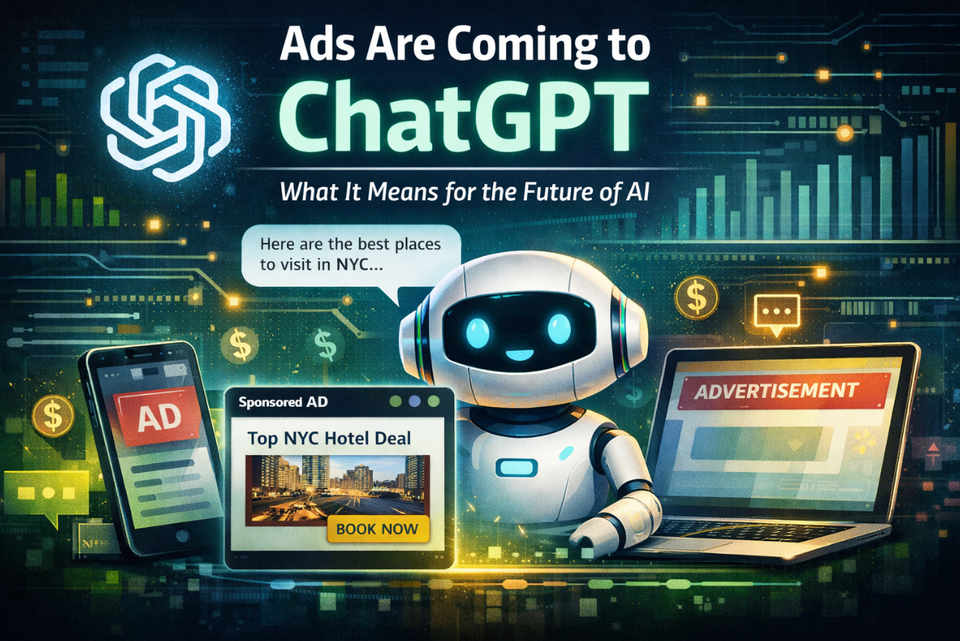
This week, OpenAI confirmed it will begin testing advertisements inside ChatGPT, starting in the United States. Ads will appear below responses, clearly labelled, and the company insists they won’t influence the answers themselves.
On paper, this sounds reasonable.
In reality, it marks a major shift in how one of the most trusted tools on the internet now operates.
How Ads in ChatGPT Will Work
According to OpenAI, ads will be:
- Displayed only after a response, in a separate box
- Clearly labelled as advertisements
- Shown to free and low-cost tier users
- Absent from Plus, Pro, and Enterprise plans
Crucially, OpenAI says:
- Conversations won’t be sold to advertisers
- User data won’t be exposed
- Sensitive topics like health, mental health, and politics won’t include ads
Targeting will instead rely on conversation context, not traditional demographic profiling.
Ask ChatGPT how to plan a trip to New York, and you may see a hotel ad underneath the answer.
The response stays neutral.
The monetisation happens after.
At least, that’s the promise.
Why This Was Always Inevitable
ChatGPT now serves hundreds of millions of users every week, most of whom never pay.
That puts OpenAI in familiar territory.
Every large consumer platform eventually faces the same pressure:
- Massive infrastructure costs
- Investor expectations
- Competition from equally well-funded rivals like Google
OpenAI has raised tens of billions of dollars and, by its own admission, generates only a fraction of that in revenue. Subscriptions alone were never going to be enough.
Ads weren’t a question of if — only when.
The Trust Problem Nobody Can Avoid
Here’s the uncomfortable truth:
Even if ads don’t influence responses today, the perception shift has already happened.
The moment advertising enters an interface:
- Users start questioning neutrality
- Recommendations feel less absolute
- Trust becomes conditional
This is the same slow erosion that happened with search engines, social media feeds, and content platforms over the last two decades.
OpenAI’s leadership openly acknowledges the failures of the social media era. They say they’re prioritising user trust over engagement metrics and experience over revenue.
That’s encouraging.
But incentives have a habit of changing behaviour over time.
Conversational Ads Are a Slippery Concept
OpenAI has hinted at interactive ads, where users could ask follow-up questions directly within the ad experience.
That’s powerful.
And potentially dangerous.
The line between:
- “Here’s an answer”
- and “Here’s a suggestion”
can blur very quickly in conversational interfaces.
Unlike banner ads, language feels authoritative.
Especially when it comes from a system people already rely on for decisions.
The Bigger Question Isn’t Ads – It’s Precedent
Ads in ChatGPT don’t break the product overnight.
But they do set a precedent.
Once monetisation exists:
- Expansion becomes easier
- Boundaries become negotiable
- Exceptions slowly grow
The internet is full of platforms that started with good intentions and ended up optimising for revenue instead of users.
OpenAI knows this.
Users know this.
And history isn’t exactly reassuring.
Final Thought
ChatGPT adding ads isn’t shocking.
What matters is what happens next.
If OpenAI can genuinely keep:
- Answers unbiased
- Ads clearly separated
- User trust intact
Then this could become a rare example of monetisation done carefully.
But if history tells us anything, it’s this:
The moment a product becomes indispensable, the pressure to extract more value from it never really stops.
And once trust erodes, it’s almost impossible to rebuild.
Member discussion